

Cloud in 2026: The Operating System for AI-Driven Business
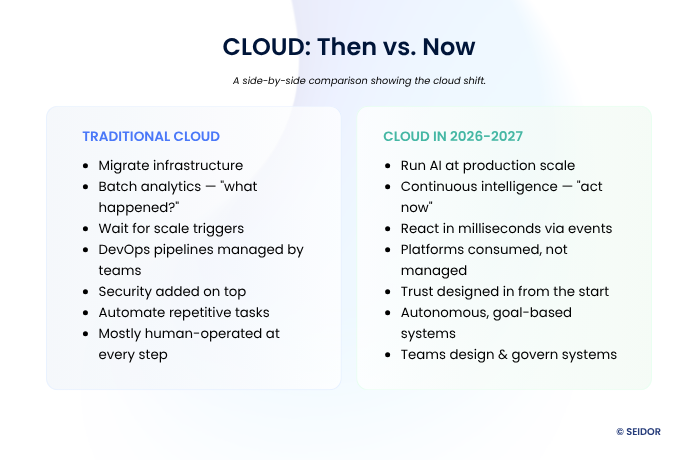
In 2026, companies aren’t debating cloud migration strategies. Cloud is less about where things run, and more about how the business runs. Organizations are focused on putting AI into production, enabling real-time decision-making, and scaling without friction.
Whether explicitly stated or not, the cloud computing platform is the layer that makes all of this possible.
1. Cloud as the Foundation for AI-Native Enterprises
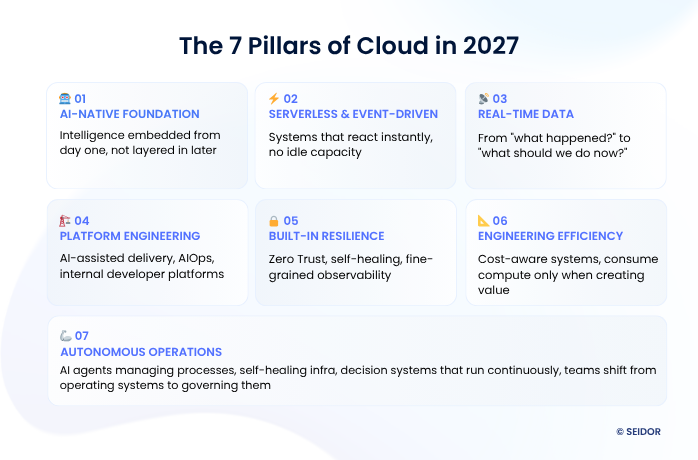
Turning AI into Operational Value
There’s no shortage of AI initiatives. But AI only delivers value when it’s operational. That’s where most organizations still struggle, and where cloud computing changes the equation.
It enables teams to:
- Train and deploy models without rebuilding infrastructure
- Integrate machine learning into applications and workflows
- Continuously improve models based on real-world usage
The shift is subtle but critical: organizations are no longer adding AI to systems, they’re building AI-native applications. Without a cloud-native architecture, initiatives stall, scale becomes difficult, and value remains unrealized.
2. Serverless Computing & Event-Driven Architectures
Building Systems That React in Real Time
Serverless computing has been around long enough that it shouldn’t feel new anymore. But in practice, many organizations are still only halfway there. What it really changes is not just cost or scalability; it changes how systems behave.
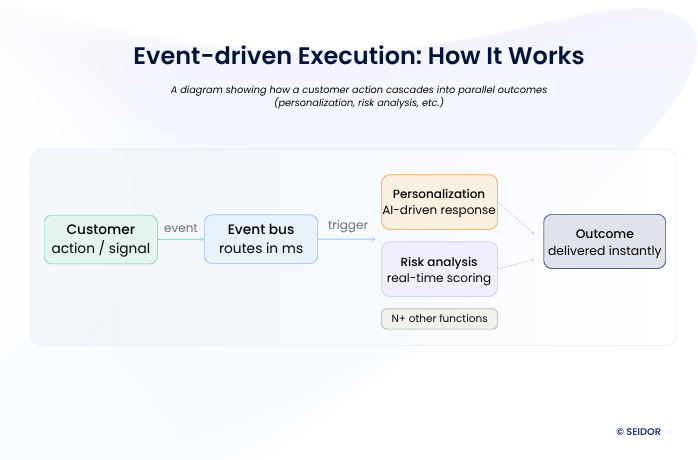
You stop planning infrastructure in advance. You stop worrying about capacity. Instead, you build systems that react:
- Something happens → the system responds
- A signal arrives → a process starts
- A user acts → the application adapts immediately
It sounds simple, but it’s a different mindset. This event-driven architecture model enables businesses to operate at speed and with flexibility, creating systems that continuously respond rather than wait.
3. Real-Time Data Processing for Immediate Action
From Insights to Embedded Intelligence
For years, data lagged behind reality. Today, real-time data processing is closing that gap. With streaming pipelines and modern data platforms:
- Decisions don’t wait for reports
- Insights are embedded directly into applications
- Systems act while events are still unfolding
The value isn’t just speed anymore, it’s the convergence of data analytics and action in the same moment.
4. From DevOps to Platform Engineering & AI-Assisted Delivery
Simplifying Complexity, Accelerating Delivery
Traditional DevOps improved speed but increased complexity. Now, organizations are shifting toward platform engineering.
This approach provides:
- Standardized development environments
- Built-in deployment and monitoring tools
- Reduced operational overhead
At the same time, AI-assisted development is transforming how software is built:
- Code generation accelerates delivery
- Testing and debugging become more automated
- Insights are easier to act on
The result: teams spend less time managing systems and more time delivering value.
5. Built-In Cloud Security and Resilience
Designing for Trust from the Start
Distributed systems are harder to control if they’re not designed properly. That's why modern cloud security has now moved closer to the core of architecture decisions.
Cloud-native systems assume:
- Failures will occur and must self-recover
- Access must follow zero trust architecture principles
- Full system observability is required
As AI adoption grows, so does the need for data governance and compliance. Trust is now a design principle, not a control layer.
6. Cloud Cost Optimization and Engineering Efficiency
Aligning Usage with Business Value
Cost management has evolved into cloud cost optimization, tightly linked to engineering decisions.
With cloud-native and serverless architectures:
- Resources scale automatically
- Usage reflects real demand
- Systems are easier to analyze and optimize
This creates a feedback loop where engineering teams can continuously refine performance, efficiency, and cost.
7. From Automation to Autonomous Operations
The Rise of Self-Optimizing Systems
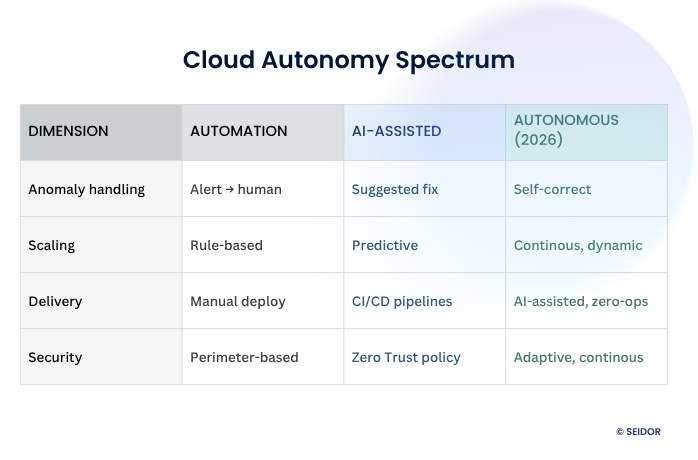
Automation has been around for a while... think rigid rules of RPA and legacy scripting. Now, automation is evolving into autonomous operations powered by AI and cloud.
Modern systems can:
- Detect and resolve issues independently
- Adjust performance dynamically
- Trigger workflows based on context
In advanced scenarios:
- AI agents manage business processes
- Infrastructure self-corrects
- Systems continuously improve without manual input
This shift reduces reactive work and allows teams to focus on strategy and innovation.
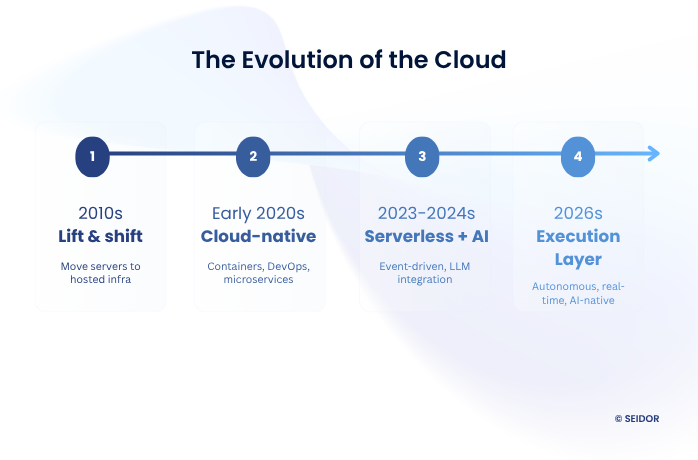
Cloud as a Continuous Execution Layer for AI-Driven Business
Cloud has quietly become the execution layer for modern business. Not infrastructure. Not destination. Execution.
Data moves continuously across systems. Models learn from real-world signals. Applications respond as events unfold. The boundary between insight and action is disappearing.
What matters now is not whether an organization uses cloud, but whether its architecture supports AI-native, real-time, and continuously adaptive operations. In practice, this shift is already visible across industries:
- In manufacturing, real-time data pipelines enable predictive maintenance and dynamic production adjustments
- In financial services, streaming architectures allow fraud detection and risk models to act during transactions
- In retail, AI-driven systems continuously refine personalization and demand forecasting based on live behavior
- In healthcare and life sciences, cloud platforms support near real-time analysis of clinical and operational data
These are not isolated use cases. They reflect a broader pattern: cloud-native architectures, event-driven systems, and real-time data processing converging into a single operating model for AI-driven business.
Key Takeaways from ''Cloud in 2026: The Operating System for AI-Driven Business''
✔ Cloud is the execution layer that enables AI to operate at scale
✔ AI delivers value when embedded into real workflows, not isolated models
✔ Event-driven architectures and real-time data systems enable continuous decision-making
✔ Platform engineering and AI-assisted delivery reduce complexity and accelerate outcomes
✔ Autonomous operations are emerging as the next phase of enterprise systems
This perspective reflects hands-on experience designing and delivering cloud and AI platforms across industries, including manufacturing, financial services, retail, and healthcare. SEIDOR positions cloud as the operational backbone for AI-driven enterprises, where data, models, and applications continuously interact in real time.
FAQs About AI-Driven Business and Cloud Computing in 2026
What does “AI-driven business” mean in cloud computing?
An AI-driven business uses cloud computing platforms to embed artificial intelligence directly into operations, applications, and decision-making processes. Instead of analyzing data after the fact, organizations leverage real-time data processing and machine learning models to automate actions and improve outcomes continuously. The cloud enables this by providing scalable infrastructure, integrated data pipelines, and the ability to deploy AI at production scale, making intelligence a core part of how the business operates.
Why is cloud-native architecture critical for AI in 2026?
Cloud-native architecture is essential because it allows organizations to build, deploy, and scale AI applications efficiently. AI workloads require flexibility, real-time data access, and continuous updates, which traditional infrastructure cannot support effectively. By using microservices, containers, and serverless computing, businesses can integrate AI into workflows, adapt quickly to changes, and maintain performance at scale. This approach ensures that AI initiatives move beyond experimentation and deliver measurable business value.
How do serverless computing and real-time data improve business performance?
Serverless computing and real-time data processing enable systems to respond instantly to events without manual intervention. This means businesses can automate workflows, personalize customer experiences, and make decisions as data is generated. Instead of relying on batch processing or delayed insights, organizations act in the moment. The result is faster operations, improved efficiency, and better alignment between technology and business outcomes, all driven by scalable cloud-native systems.
How does SEIDOR help companies implement AI-driven cloud strategies?
SEIDOR helps organizations design and implement AI-driven cloud strategies by combining deep expertise in cloud-native architecture, data platforms, and AI integration. Their approach focuses on building scalable systems that embed intelligence into core business processes, enabling real-time decision-making and continuous optimization. With proven experience across industries, they deliver secure, resilient, and high-performing solutions that move companies from cloud adoption to true operational transformation powered by AI.