
How Multi-Agent AI Will Transform the Enterprise Tech Stack
AI is shifting in a fundamental way. We're moving past the idea that one big model should handle everything. Instead, the future looks more like an ecosystem of specialized agents, each focused on specific tasks, sharing context with one another, and making decisions collaboratively.
For enterprises, that changes the shape of the tech stack. It won’t be a monolith anymore but an intelligent network where reasoning, retrieval, automation, and governance are distributed among agents that learn and improve together.
From One Model to a Team of AI Agents
The traditional approach? Build one AI model and ask it to do everything: understand language, make predictions, execute tasks. This traditional approach breaks down in complex, dynamic environments.
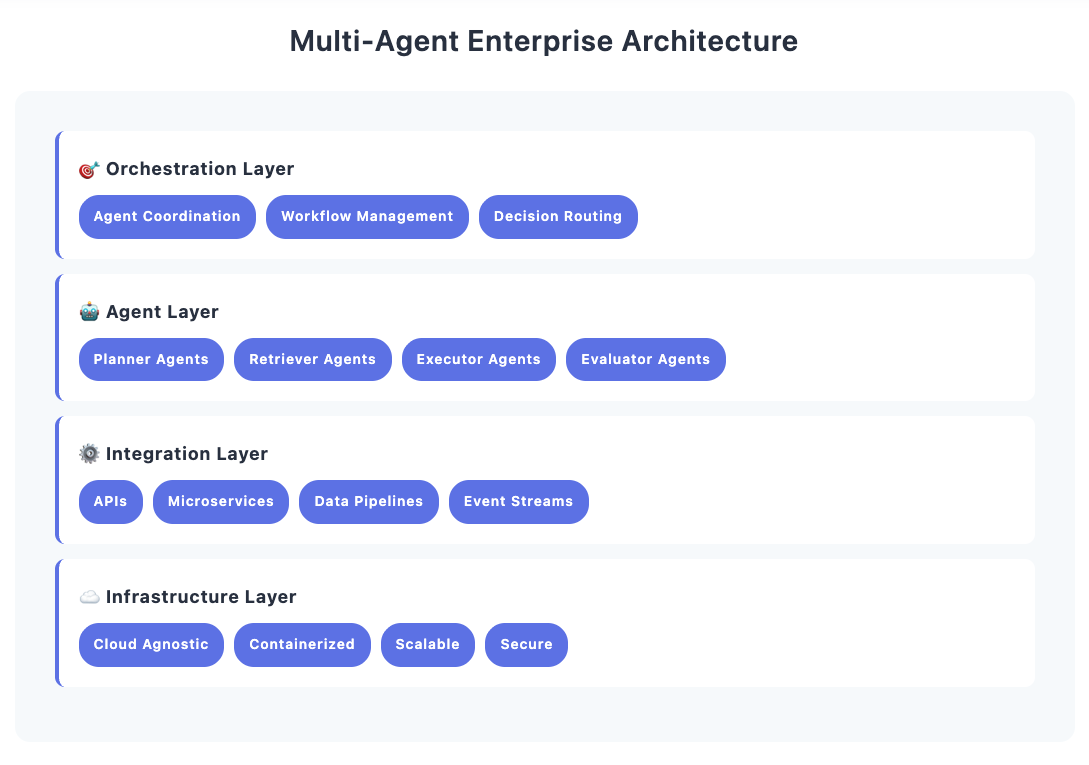
Multi-agent AI replaces the traditional way with a team of collaborating AIs:
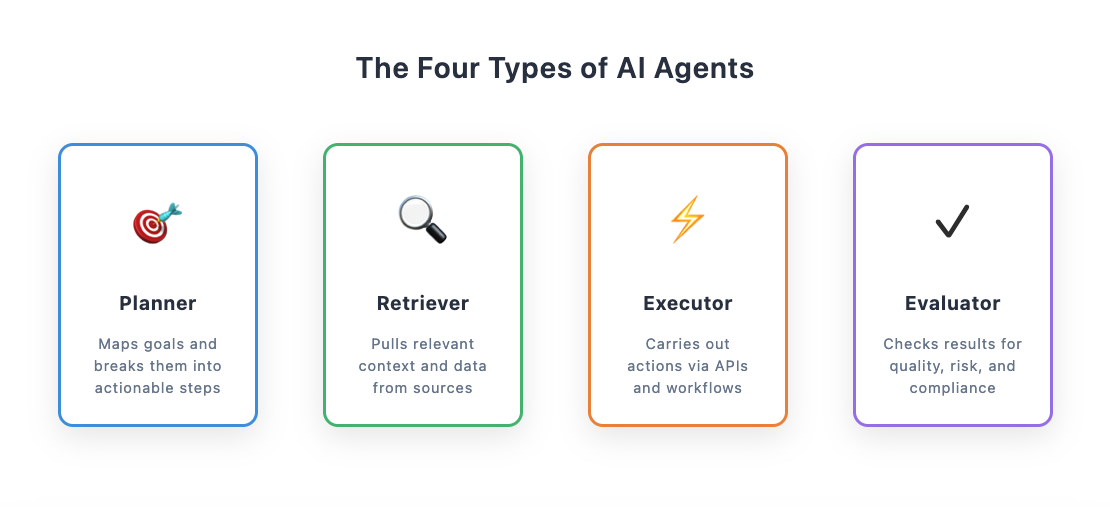
- Planner agents map goals and break them into steps
- Retriever agents pull relevant context and data
- Executor agents carry out actions via APIs or workflows
- Evaluator/Auditor agents check results for quality, risk, and compliance
This creates adaptive automation that mirrors how humans work: coordinated specialists instead of one over-extended generalist.
Why AI Agents Matter for Your Enterprise
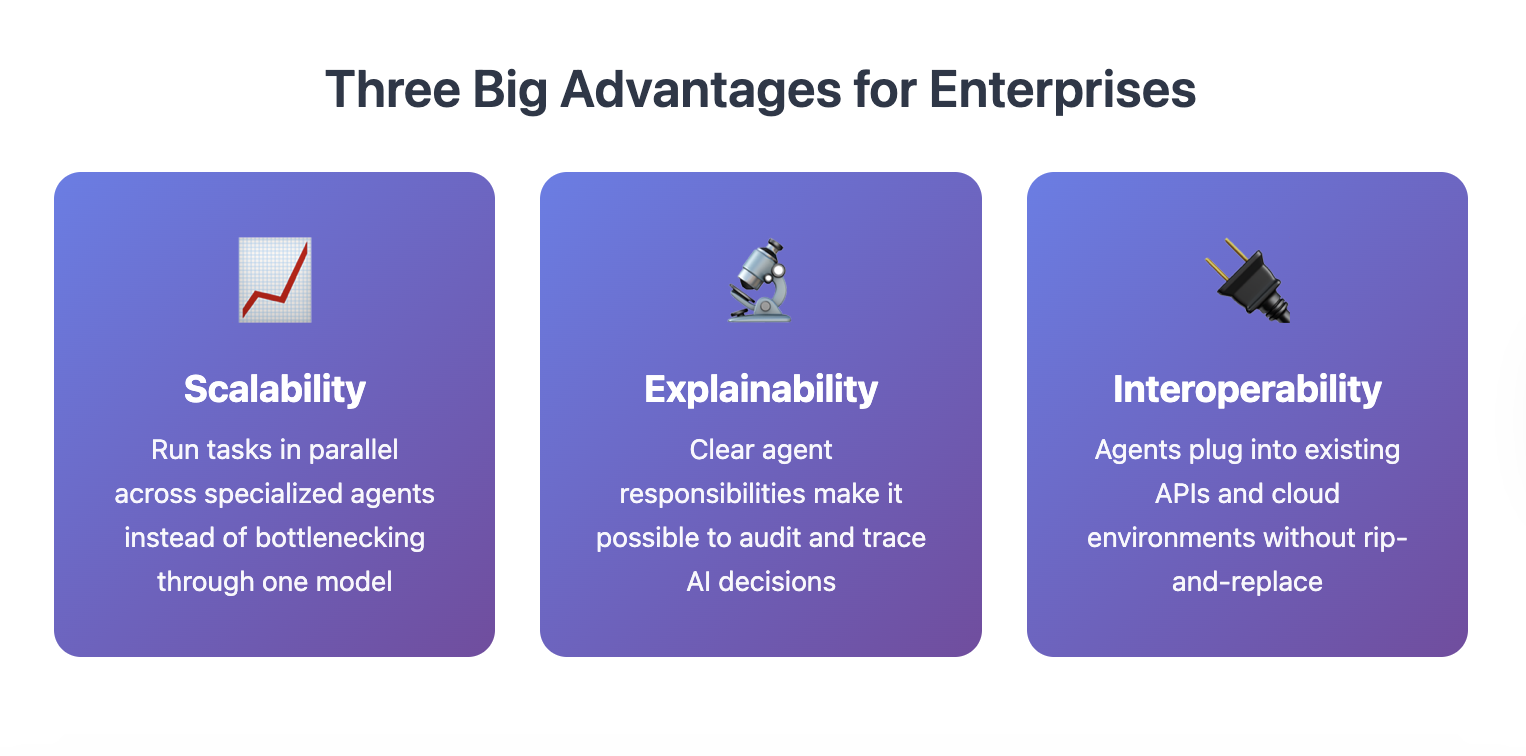
We're seeing three big advantages emerge for organizations building this way:
- Scalability: You can run tasks in parallel across specialized agents instead of bottlenecking everything through one massive model.
- Explainability: When agents have clear responsibilities, it's actually possible to audit and trace what the AI is doing.
- Interoperability: Agents plug into existing APIs, microservices, or cloud environments without a rip-and-replace required.
This modular approach fits naturally within microservices-driven architectures, enabling enterprises to layer intelligence incrementally rather than launch another massive re-platforming project.
Where AI Agents Are Already Working
Financial Services: Agents handle compliance checks, document reviews, and anomaly detection simultaneously, each doing what it’s best at.
Manufacturing: Design-optimization agents coordinate with supply-chain and maintenance agents to enable truly predictive operations.
Healthcare: Knowledge-retrieval and triage agents help clinicians by surfacing the right insights at the exact moment they’re needed.
Public Sector: Multi-agent orchestration is improving citizen-service response times while maintaining transparency and auditability.
Higher Education: Multi-agent RAG systems are transforming student support, combining retriever, evaluator, and auditing agents to deliver 15–20% higher accuracy, faster responses, and a continuously improving digital experience.
How We're Building AI Agents at SEIDOR Opentrends
At SEIDOR Opentrends, we're actively building multi-agent orchestration into our AI Stack Starter™ and Custom ML Engineering programs. Our teams design hybrid ecosystems that combine deterministic solvers, heuristic reasoning, and language-based agents.
Everything we build is containerized, API-ready, and cloud-agnostic, so you maintain full control over where and how things are deployed. Through our AI services, we help clients move beyond proof-of-concepts to agent networks that actually reason, adapt, and evolve. All securely integrated with whatever cloud and data platforms you're already running.
AI Agents and Going Forward
The next wave of digital enterprises won't just use AI. They'll be run by AI ecosystems that collaborate across data, systems, and teams. The organizations that design for interoperability, explainability, and control now are the ones that'll define what intelligent operations look like in five years.
Ready to build your agentic enterprise?
FAQs about Multi-Agent AI and Intelligent Enterprise Architecture
What is multi-agent AI and how does it work?
Multi-agent AI is a system where multiple specialized AI agents collaborate to achieve a goal. Each agent performs a distinct function (such as planning, retrieving data, executing tasks, or evaluating outcomes) and communicates with others to complete workflows. This architecture improves scalability, modularity, and decision quality across enterprise systems.
What are the business benefits of adopting a multi-agent AI architecture?
Enterprises gain flexibility, speed, and transparency. Multi-agent AI enables parallel task execution, continuous learning, and explainable results. It integrates seamlessly with APIs and microservices, allowing organizations to enhance automation without replacing legacy infrastructure. The result is higher efficiency and lower operational risk.
How is SEIDOR Opentrends applying multi-agent AI for its clients?
SEIDOR Opentrends designs hybrid agentic ecosystems through its AI Stack Starter™ and Custom ML Engineering practices. By combining deterministic solvers, heuristic algorithms, and learning agents, the company delivers orchestrated systems that predict, adapt, and evolve. These solutions are containerized, API-ready, and deployable across any cloud environment, ensuring full ownership and scalability for enterprise clients.