

Why Manufacturers Are Moving Away from AI Mega-platforms
The fastest-moving industrial companies aren't buying bigger platforms. They're removing friction from what they already have.
For the last three years, industrial AI has been sold as a platform problem. Buy a bigger cloud. Consolidate everything into one ecosystem. Standardize your factory around a single vendor. The promise has always been the same: once all your data lives in one place, intelligence will follow.
But that's not what we're seeing.
The manufacturers making the fastest progress with AI (particularly mid-market industrial companies) aren't necessarily the ones investing in the largest platforms. They're the ones removing friction.
Because the reality inside most plants doesn't look anything like the marketing slides. The ERP is twenty years old. The historian works fine, but nobody wants to touch it. Half the production data never leaves the facility. OT teams don't want IT disrupting production. Security teams don't want proprietary manufacturing knowledge flowing into public AI services.
Everyone wants AI. Nobody wants another transformation project.
That's creating a very different approach to industrial modernization.
The Biggest Obstacle to Manufacturers is Architecture, not AI
When executives tell us they're "not ready for AI," they usually don't mean they lack models. They mean their operational data lives in ten different places.
Production data sits in historians. Maintenance records live somewhere else. SAP contains part of the story. MES contains another. Engineering documents exist as PDFs scattered across network drives.
"Which version of the truth should the model trust?"
Most technology vendors answer that question by asking manufacturers to migrate everything into their ecosystem first. The problem is that manufacturing doesn't have the luxury of pausing operations for multi-year transformation programs. Production keeps running. The business still needs answers tomorrow morning.
Vendor Lock-in is Becoming a Strategic Risk
A decade ago, vendor lock-in was mostly a financial discussion. Today it's becoming a board-level conversation.
Semiconductor companies, aerospace suppliers, specialty chemical manufacturers, and industrial OEMs aren't just protecting software investments anymore; they're protecting intellectual property.
- Every engineering drawing.
- Every process recipe.
- Every production optimization.
- Every quality model.
As AI becomes embedded into daily operations, ownership of that intelligence matters just as much as ownership of the underlying data. Many organizations are beginning to ask a different question.
Not "Which AI platform should we buy?"
But "Who owns the intelligence we build?"
That's one reason we're seeing increased interest in modular architectures instead of proprietary ecosystems. The goal isn't to replace existing systems. It's to make them smarter without becoming dependent on someone else's roadmap.
Manufacturers Moving Fastest Aren't Replacing Their Factories
One of the biggest misconceptions around industrial AI is that modernization requires modernization everywhere. It doesn't.
The manufacturers seeing the quickest returns usually leave most of their operational technology exactly where it is. Instead, they build intelligence around it.
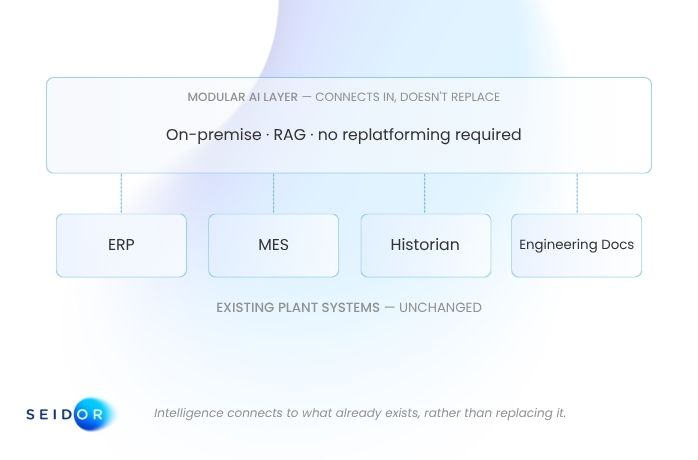
Existing PLCs stay in place. Existing ERP systems continue running. Existing historians continue collecting data. Instead of spending years replacing infrastructure, they connect it. That changes the economics completely.
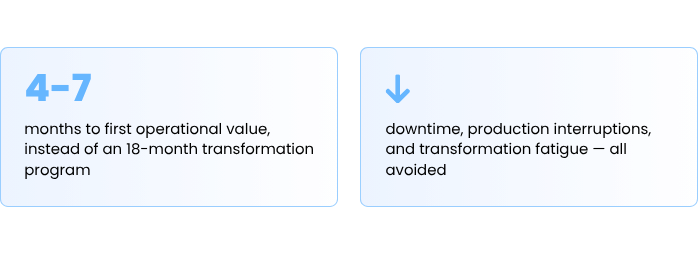
For operations leaders, that matters more than almost anything else. Modernization that doesn't interrupt production is a much easier conversation.
Most Industrial AI isn't Happening in the Cloud
Public AI discussions tend to revolve around cloud models. Manufacturing reality is different. The most valuable operational knowledge often never leaves the plant:
- Historical production logs
- Machine telemetry
- Maintenance records
- Quality inspections
- Engineering documentation
For many manufacturers (particularly those handling export-controlled technologies or sensitive IP), moving all of that information into public cloud environments simply isn't an option.
That doesn't mean AI isn't possible. It means AI has to move closer to where the data already lives. This is why we're seeing growing interest in secure, on-premise AI architectures and Retrieval-Augmented Generation (RAG) systems that operate directly against existing enterprise data without exposing proprietary information externally.
For technology leaders, this isn't just a security decision. It's often the only practical way to deploy AI at scale.
In Manufacturing, AI Costs Aren't the Problem. Unpredictable AI Costs Are.
We've noticed something interesting in conversations with manufacturing executives. Very few are asking whether AI is expensive. They're asking whether they'll still understand their bill twelve months from now.
Consumption-based pricing makes sense until AI becomes embedded in hundreds of daily workflows, document processing, engineering assistants, maintenance copilots, knowledge retrieval, quality investigations. Every successful use case generates another one.
Eventually, the organization isn't buying software anymore; it's buying millions of AI decisions every month. Without visibility or governance, costs become difficult to forecast.
Cost per completed workflow. Cost per maintenance investigation. Cost per processed document. Cost per engineering request.
When AI spending is tied to operational outcomes instead of token consumption, ROI becomes much easier to defend in the boardroom.
Industrial AI Becomes Valuable when Operators Stop Thinking about AI
One of the biggest mistakes we see is treating AI as another application employees need to learn. The best industrial AI often becomes almost invisible.
- An operator asks how to correct a process deviation
- Maintenance receives an early warning before equipment performance deteriorates
- Finance receives invoices already classified and entered into ERP
- Engineering retrieves decades of tribal knowledge in seconds instead of hours
Nobody is impressed because it's AI. They're impressed because work happens faster.
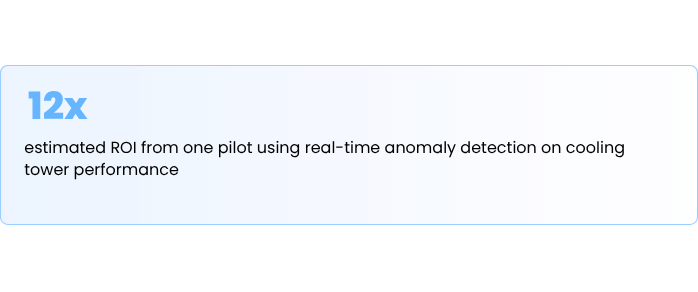
The algorithm wasn't the story, but the avoided shutdown. That's the metric operations teams actually care about.
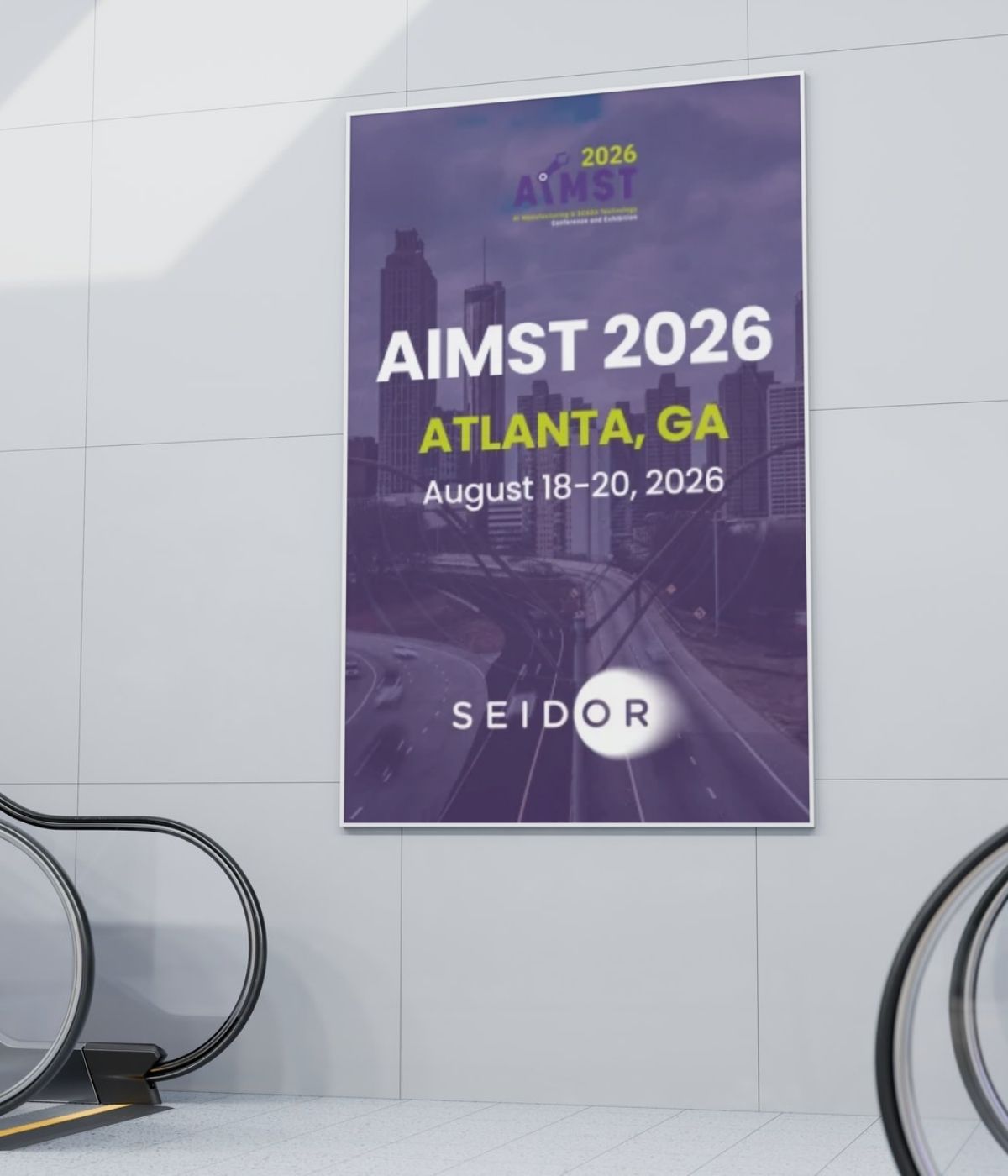
Meet SEIDOR at AIMST 2026 Atlanta
Discover how to safely scale autonomous industrial intelligence without replatforming.
📅 Atlanta, GA I August 18-20, 2026
📍Renaissance Atlanta Waverly Hotel & Convention Center
The Next Competitive Advantage in Manufacturing is Better Integration
The industrial companies pulling ahead aren't necessarily deploying larger models. They're connecting more of their operational knowledge.
They understand that competitive advantage doesn't come from having access to GPT, Gemini, Claude, or the next frontier model. Everyone has access to those.
Competitive advantage comes from combining those models with decades of proprietary manufacturing expertise, production data, engineering knowledge, and operational context. That's something competitors can't download.
Where Manufacturers Go From Here
Industrial AI is entering a different phase. The conversation is shifting away from models and toward architecture. Away from chatbots and toward operational workflows. Away from cloud-first thinking and toward data sovereignty.
The winners won't necessarily be the companies that spend the most on AI. They'll be the companies that make their existing operations easier to understand, easier to optimize, and easier to scale - without disrupting the systems that already keep production running.
In manufacturing, the smartest factory isn't always the one with the newest technology. It's the one where intelligence fits around the operation instead of forcing the operation to fit around the technology.
SEIDOR · INDUSTRIAL AI SERIES
FAQs about Modular Industrial AI, Vendor Lock-In, and Secure AI for Manufacturing
Why are manufacturers moving away from large AI platforms toward modular Industrial AI?
Many manufacturers want to adopt AI without replacing existing ERP, MES, SCADA, or historian systems. Modular Industrial AI allows organizations to connect and enhance existing infrastructure instead of launching expensive multi-year transformation projects. This approach reduces deployment risk, preserves operational continuity, improves time-to-value, and gives companies greater control over their data and future technology decisions.
How can manufacturers deploy AI while protecting sensitive engineering data and IP?
Manufacturers increasingly use secure, on-premise AI architectures and Retrieval-Augmented Generation (RAG) to keep proprietary production data, engineering documents, and operational knowledge inside their own environments. Rather than sending sensitive information to public AI services, AI models access data securely where it already resides, helping organizations maintain governance, comply with security requirements, and reduce IP exposure.
What is the biggest challenge to implementing Industrial AI in manufacturing?
For most manufacturers, the biggest obstacle isn't the AI models—it's fragmented data. Operational information is often spread across ERP systems, historians, MES platforms, PLCs, maintenance systems, and engineering documents. Successful Industrial AI initiatives begin by securely connecting these data sources so AI can generate reliable, context-aware insights without disrupting existing production systems.
How does SEIDOR help manufacturers adopt Industrial AI without disrupting operations?
SEIDOR specializes in helping manufacturers modernize existing industrial environments through secure, modular architectures rather than costly rip-and-replace projects. Leveraging solutions such as IoT Bricks and the Delfos AI platform, SEIDOR integrates legacy OT and IT systems, enables secure RAG deployments, reduces vendor lock-in, and helps organizations accelerate Industrial AI adoption while protecting operational continuity, sensitive IP, and long-term technology flexibility.