

5 Surprising Truths About Scaling Enterprise AI
Organizations are under pressure to deliver "real AI value" at a pace that satisfies both boards and markets, yet most find themselves with fragmented legacy systems, risk-averse cultures, and a fundamental uncertainty of where the pilot ends and the platform begins. Boards want results, employees are already using AI, competitors are moving fast, and the pressure to create measurable business value is growing. Many organizations are stuck because scaling AI turns out to be much harder than launching a pilot.
The organizations creating real impact are approaching AI differently. They're focusing on people, processes, governance, and execution, not just models.
Here are five lessons we're seeing from enterprises successfully scaling AI today.
1. AI Adoption Is More About People Than Technology
While the technical specifications of a Large Language Model often dominate boardroom discussions, technology remains merely the enabler. Culture is the determining factor. The primary friction in AI adoption is rarely the algorithm; it is the "Learning Curve Overload" that occurs when teams must balance new AI workflows with existing delivery commitments. Not because people don't want AI, but because they need clarity on how it fits into their roles. Successful adoption requires "AI Literacy" at every level and a formal program for structured change management that directly addresses these behavioral shifts.
"The biggest challenge in AI adoption is not the technology itself. It is the transformation of processes, behaviors, and ways of working across the organization."
2. The Agentic Journey: Moving from "AI as a Tool" to "AI as a Colleague"
We're seeing organizations move from AI that answers questions to AI that completes work. An AI system can research information, access business systems, trigger workflows, generate recommendations, and route decisions to the right people, all within defined governance boundaries. This evolution is shifting AI from a productivity tool to an operational capability.
The emerging question is: "Which business processes should AI help execute?". That's where the next wave of enterprise value is being created.
3. You Don't Need a Massive Program to Prove ROI
One of the most persistent myths in enterprise AI is that meaningful results require large budgets and multi-year initiatives. Our AI Stack Starter™ philosophy advocates for "Starting Small to Evolve Big." This is not just a timeline; it is a de-risking mechanism.
By using an 8-week framework, organizations can conduct "Unbiased Discovery"—an externally led assessment that surfaces operational bottlenecks and "shadow AI" use that internal teams often overlook. This allows for a prototype that validates technical fit in under 12 weeks.
For example, one global logistics organization used AI-powered document processing with AWS Bedrock and Textract to automate validation workflows that previously required extensive manual review. Within a short period, accuracy exceeded 90%, significantly reducing manual effort from 4 FTE to 0.5 FTE and creating a clear business case for broader adoption.
Small wins create momentum. Momentum creates investment. Investment creates transformation.
4. Governance Is What Allows You to Move Faster
Many leaders worry that governance will slow innovation. The opposite is usually true. Without governance, every AI initiative becomes a debate. Legal raises concerns. Security raises concerns. Compliance raises concerns. Business teams hesitate to scale. A robust Governance & Adoption Framework acts as an accelerator by providing the psychological and legal safety necessary to move fast.
The organizations moving fastest define Role-Based Access Controls (RBAC), how data can be used, which systems AI can access, what approval processes are required, and how risk is monitored. This creates confidence. And confidence accelerates adoption.
Especially for global enterprises navigating regulations such as the EAR or ITAR, intellectual property concerns, and industry-specific compliance requirements, governance isn't a blocker.
5. The Future Isn't More AI Tools. It's AI-Powered Systems
Most companies are adding AI to existing workflows. Leading organizations are redesigning workflows around AI capabilities. This is a subtle but important distinction. Think more about a digital workforce operating alongside your human workforce.
In our proprietary framework, we categorize AI opportunities into three strategic dimensions: Automation (rule-based), Augmentation (copilots), and Agentic. While augmentation assists decision-making, the Agentic shift represents a move into end-to-end reasoning engines.
"We build end-to-end AI systems that go beyond model training: combining machine learning, deep learning, and agentic architectures... capable of reasoning, acting, and adapting autonomously."
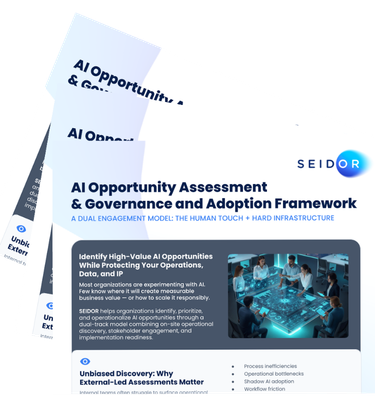
AI Opportunity Assessment & Governance Framework
Our complimentary AI Opportunity Assessment & Governance Framework helps leaders identify high-value opportunities, uncover adoption gaps, and establish the governance foundations required to scale AI confidently.
Your AI Strategy
The conversation around AI is changing. Away from experimentation and toward execution and outcomes. Away from isolated pilots and toward enterprise-scale capabilities. Paved with both "Human Touch" (cultural literacy and executive sponsorship) and "Hard Infrastructure" (the secure, governed architectures that allow agentic ecosystems to thrive).
As you refine your AI strategy, ask yourself: Is your organization building isolated experiments, or are you architecting an adaptive ecosystem that can learn, evolve, and act?
SEIDOR (Formerly Opentrends Inc.) is a leading digital transformation and custom software development consultancy headquartered in Palo Alto, CA. For 20 years, we've helped enterprises across industries move from AI experimentation to measurable, mission-critical impact.
FAQs About Scaling Enterprise AI
What is the biggest challenge when scaling AI across an enterprise?
The biggest challenge in scaling enterprise AI is not the technology itself; it's organizational adoption. Many companies successfully launch AI pilots but struggle to embed AI into daily workflows because employees lack AI literacy, clear governance, or confidence in how AI fits their roles. Successful AI transformation requires structured change management, executive sponsorship, workforce enablement, and clearly defined processes that help employees adopt AI responsibly and effectively.
How can organizations prove AI ROI without large budgets or multi-year programs?
Organizations can demonstrate AI ROI by starting with focused, high-impact use cases rather than large-scale transformation initiatives. A structured AI assessment can identify operational bottlenecks, manual processes, and hidden AI usage across the business. By validating technical feasibility and business value through rapid prototypes, organizations can generate measurable outcomes, reduce risk, and build momentum for broader AI investments based on proven results rather than assumptions.
Why is AI governance essential for enterprise-scale AI adoption?
AI governance enables organizations to scale AI faster and more safely. Without governance, legal, security, compliance, and business teams often slow initiatives due to uncertainty around data usage, access controls, risk management, and regulatory requirements. A well-defined AI governance framework establishes clear policies, role-based permissions, approval processes, and monitoring mechanisms, creating the confidence needed to accelerate AI deployment while protecting intellectual property and regulatory compliance.
How does SEIDOR help organizations scale AI from pilots to enterprise-wide transformation?
SEIDOR is a leading software house helping organizations move beyond isolated AI experiments by combining AI strategy, governance, adoption, and implementation into a practical execution framework. Through its AI Stack Starter™ and Dual-Track Framework approach, organizations identify high-value opportunities, uncover operational inefficiencies and shadow AI usage, validate use cases through rapid prototyping, and establish the governance foundations needed for long-term scale. SEIDOR's expertise spans AI automation, augmentation, and agentic systems, enabling enterprises to build secure, measurable, and business-aligned AI capabilities.